Training Course on Scenario Planning and Future-Proofing the Enterprise
Training Course on Scenario Planning and Future-Proofing the Enterprise equips business leaders and strategic professionals with the essential tools, methodologies, and mindset to proactively navigate ambiguity, identify emerging opportunities, and build resilient, adaptive strategies that ensure long-term organizational sustainability and competitive advantage
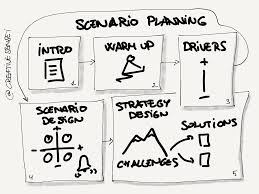
Course Overview
Training Course on Scenario Planning and Future-Proofing the Enterprise
Introduction
In today's dynamic and volatile global landscape, organizations face unprecedented levels of uncertainty and disruption. Traditional forecasting methods often fall short in anticipating rapid shifts in markets, technologies, and societal trends. Training Course on Scenario Planning and Future-Proofing the Enterprise equips business leaders and strategic professionals with the essential tools, methodologies, and mindset to proactively navigate ambiguity, identify emerging opportunities, and build resilient, adaptive strategies that ensure long-term organizational sustainability and competitive advantage.
This program goes beyond mere prediction, fostering a culture of strategic foresight that empowers participants to anticipate potential futures, develop robust contingency plans, and make informed, agile decisions in the face of the unknown. Through experiential learning and real-world case studies, attendees will master the art of constructing plausible future narratives, identifying critical uncertainties, and designing strategies that thrive across a spectrum of possible outcomes, ultimately enabling their enterprises to not just survive, but flourish in an unpredictable future.
Course Duration
10 days
Course Objectives
- Master Strategic Foresight principles for proactive future analysis.
- Develop Robust Scenario Methodologies to navigate complexity and VUCA environments.
- Identify and analyze Megatrends and Weak Signals for early warning detection.
- Construct Plausible Future Narratives using System Thinking and Causal Layered Analysis.
- Formulate Adaptive Strategies that are resilient to disruption and future shocks.
- Integrate Scenario Planning with Organizational Strategy and Decision-Making Processes.
- Enhance Risk Mitigation and Opportunity Identification through Scenario-Based Risk Management.
- Cultivate an Agile Mindset and Organizational Adaptability for continuous evolution.
- Leverage Data-Driven Foresight and AI in Scenario Modeling for enhanced accuracy.
- Facilitate Stakeholder Alignment and Collaborative Future Visioning within the enterprise.
- Design Future-Proof Business Models and Innovation Roadmaps.
- Measure and monitor Strategic Preparedness using Key Performance Indicators (KPIs).
- Lead Transformational Change and foster a culture of Continuous Learning and Future Readiness.
Organizational Benefits
- Organizations will be better equipped to withstand unforeseen market shifts, technological disruptions, and geopolitical uncertainties.
- Leaders will make more informed and timely decisions by understanding a wider range of potential futures and their implications.
- The ability to identify and mitigate potential risks before they materialize, reducing financial losses and reputational damage.
- By exploring alternative futures, organizations can uncover emerging markets, innovative solutions, and competitive advantages.
- Fosters a culture where the enterprise can pivot and adjust its strategies rapidly in response to changing external environments.
- Enables more strategic investment in areas that will yield the greatest returns across multiple future scenarios.
- Demonstrates a proactive and responsible approach to future challenges, building trust with investors, employees, and customers.
- Drives a continuous cycle of innovation and strategic renewal, ensuring long-term viability and growth in a complex world.
Target Audience
- Senior Executives and C-Suite Leaders
- Strategic Planning Professionals
- Innovation and R&D Managers.
- Risk Management and Compliance Officers.
- Business Development Managers
- Heads of Departments/Divisions
- Consultants and Advisors
- Project and Program Managers.
Course Outline
Module 1: Introduction to Strategic Foresight and Future-Proofing
- Defining Strategic Foresight, Scenario Planning, and Future-Proofing.
- The Urgency of Foresight in a VUCA (Volatile, Uncertain, Complex, Ambiguous) World.
- Distinguishing Scenario Planning from Traditional Forecasting.
- Key Benefits of a Future-Oriented Mindset for Enterprises.
- Case Study: Nokia's missed opportunities vs. Apple's foresight in mobile technology.
Module 2: Understanding the Drivers of Change
- Identifying Megatrends: Societal, Technological, Economic, Environmental, Political (STEEP/PESTEL).
- Spotting Weak Signals and Emerging Issues.
- Analyzing Critical Uncertainties and their potential impact.
- The Interconnectedness of Global Trends.
- Case Study: The rise of remote work post-pandemic as a weak signal becoming a megatrend.
Module 3: Framing the Scenario Planning Challenge
- Defining the Focal Question: What future question are we trying to answer?
- Setting the Time Horizon for Scenario Development.
- Boundary Conditions and Scope Definition.
- Identifying Key Stakeholders and their influence.
- Case Study: A pharmaceutical company framing a scenario around future healthcare regulations.
Module 4: Identifying Key Drivers and Uncertainties
- Brainstorming and Prioritizing Driving Forces.
- Distinguishing Predetermined Elements from Critical Uncertainties.
- Developing an Uncertainty Matrix.
- Quantitative vs. Qualitative Drivers.
- Case Study: An automotive manufacturer identifying electrification and autonomous driving as key uncertainties.
Module 5: Constructing Scenario Narratives
- Developing Plausible and Internally Consistent Scenarios.
- The "2x2 Matrix" Approach to Scenario Development.
- Crafting Compelling and Evocative Scenario Titles.
- Writing Rich and Detailed Scenario Narratives.
- Case Study: Shell's historical scenario planning for energy futures.
Module 6: Analyzing Scenario Implications
- "Windtunneling" Strategies against Scenarios.
- Identifying Opportunities and Threats within each Scenario.
- Assessing the Impact on Business Models, Operations, and Culture.
- Uncovering Robust Strategies that perform well across multiple scenarios.
- Case Study: A retail chain evaluating supply chain vulnerabilities across different economic downturn scenarios.
Module 7: Integrating Scenarios into Strategic Planning
- Connecting Scenario Insights to the Strategic Planning Cycle.
- Developing Scenario-Based Strategic Options.
- Translating Scenarios into Actionable Plans and Initiatives.
- Budgeting and Resource Allocation in a Scenario-Driven Context.
- Case Study: A technology company using scenarios to inform its next 5-year product roadmap.
Module 8: Building Organizational Adaptability
- Fostering a Culture of Experimentation and Learning.
- Developing Agile Organizational Structures.
- Promoting Cross-Functional Collaboration and Knowledge Sharing.
- Empowering Employees for Responsive Decision-Making.
- Case Study: Netflix's continuous adaptation from DVD rentals to streaming and content creation.
Module 9: Risk Management and Resilience
- Proactive Risk Identification through Scenarios.
- Developing Contingency Plans and Business Continuity Strategies.
- Stress-Testing Existing Plans against Extreme Scenarios.
- Building Financial and Operational Resilience.
- Case Study: A financial institution preparing for cybersecurity breaches under various digital transformation scenarios.
Module 10: Innovation and Future Business Models
- Using Scenarios to Spur Breakthrough Innovation.
- Designing Future-Proof Business Models.
- Exploring New Value Propositions and Ecosystems.
- Identifying Emerging Technologies and their potential impact.
- Case Study: Airbnb disrupting the hospitality industry by leveraging foresight into changing consumer preferences.
Module 11: Leadership and Communication for Future-Proofing
- Leading through Uncertainty and Ambiguity.
- Communicating Complex Scenarios to Stakeholders.
- Building Consensus and Driving Organizational Buy-in.
- Developing a Vision for a Preferred Future.
- Case Study: A CEO effectively communicating a new strategic direction based on scenario analysis to the board and employees.
Module 12: Monitoring and Adapting Strategies
- Identifying Early Warning Indicators and Trigger Points.
- Establishing a System for Continuous Environmental Scanning.
- Regularly Reviewing and Updating Scenarios and Strategies.
- Metrics and KPIs for Measuring Strategic Preparedness.
- Case Study: A telecommunications company continuously monitoring technological shifts and adjusting its network infrastructure plans.
Module 13: Practical Application Workshop: Developing Your Own Scenarios
- Hands-on Exercise: Participants work in teams to apply learned methodologies.
- Defining a Real-World Focal Question for their own context.
- Brainstorming and Mapping Key Drivers and Uncertainties.
- Developing and Presenting their own Scenario Narratives.
- Case Study: Participants apply the process to their own organizational challenges.
Module 14: Integrating AI and Data in Scenario Planning
- Leveraging Predictive Analytics and Machine Learning for Foresight.
- AI Tools for Trend Analysis and Pattern Recognition.
- Data Visualization for Scenario Communication.
- Ethical Considerations in AI-Driven Foresight.
- Case Study: How a logistics company uses AI to predict supply chain disruptions based on global events.
Module 15: The Future-Proofing Journey: Next Steps
- Building an Internal Foresight Capability.
- Creating a Culture of Continuous Learning and Adaptation.
- Overcoming Obstacles to Scenario Planning Implementation.
- Developing a Personal Action Plan for Future-Proofing.
- Case Study: Organizations that have successfully embedded foresight into their DNA (e.g., some leading technology firms).
Training Methodology
This course employs a highly interactive and experiential learning methodology designed to maximize engagement and practical application. It combines:
- Instructor-Led Sessions: Expert-led presentations providing foundational concepts and best practices.
- Interactive Workshops: Hands-on exercises and group activities for immediate application of tools and techniques.
- Real-World Case Studies: In-depth analysis of successful and unsuccessful scenario planning initiatives from diverse industries.
- Simulations and Role-Playing: Creating realistic scenarios for participants to practice decision-making under uncertainty.
- Group Discussions and Peer Learning: Fostering collaborative problem-solving and sharing of insights.
- Individual and Team Assignments: Applying course concepts to participants' own organizational contexts.
- Guest Speakers: Industry leaders sharing practical experiences and challenges.
- Q&A Sessions: Opportunities for direct interaction with instructors and experts.
Register as a group from 3 participants for a Discount
Send us an email: info@datastatresearch.org or call +254724527104
Certification
Upon successful completion of this training, participants will be issued with a globally- recognized certificate.
Tailor-Made Course
We also offer tailor-made courses based on your needs.
Key Notes
a. The participant must be conversant with English.
b. Upon completion of training the participant will be issued with an Authorized Training Certificate
c. Course duration is flexible and the contents can be modified to fit any number of days.
d. The course fee includes facilitation training materials, 2 coffee breaks, buffet lunch and A Certificate upon successful completion of Training.
e. One-year post-training support Consultation and Coaching provided after the course.
f. Payment should be done at least a week before commence of the training, to DATASTAT CONSULTANCY LTD account, as indicated in the invoice so as to enable us prepare better for you.