Training Course on Feature Store Design and Implementation
Training Course on Feature Store Design & Implementation: Centralizing and Serving Features for ML Models outlines a comprehensive training course on Feature Store Design & Implementation, a critical component of modern MLOps.
Course Overview
Training Course on Feature Store Design & Implementation: Centralizing and Serving Features for ML Models
Introduction
Training Course on Feature Store Design & Implementation: Centralizing and Serving Features for ML Models outlines a comprehensive training course on Feature Store Design & Implementation, a critical component of modern MLOps. Participants will gain practical expertise in building, managing, and leveraging robust feature stores to significantly accelerate machine learning development, enhance model performance, and ensure data consistency across diverse ML pipelines. The course emphasizes hands-on learning, empowering attendees to implement scalable and production-ready feature store solutions for real-world AI applications.
In today's data-driven machine learning landscape, managing and serving high-quality features is paramount. A well-designed feature store acts as a centralized, discoverable, and versioned repository, eliminating feature re-engineering efforts and mitigating training-serving skew. This program will equip participants with the skills to architect, implement, and operate distributed feature systems, fostering cross-functional collaboration between data scientists, ML engineers, and data engineers for optimal ML model lifecycle management.
Course Duration
10 days
Course Objectives
- Grasp the foundational principles and architectural patterns of modern feature stores.
- Learn to design robust architectures for offline and online feature serving.
- Develop efficient data pipelines to transform raw data into production-ready features.
- Implement strategies for feature version control and data lineage tracking.
- Mitigate training-serving skew through consistent feature definitions and serving.
- Design for low-latency feature serving for real-time inference.
- Gain hands-on experience with popular open-source feature store solutions like Feast.
- Seamlessly integrate feature stores into existing MLOps ecosystems and tools.
- Set up systems for feature drift detection and data quality monitoring.
- Establish best practices for data governance, access control, and feature discovery.
- Develop solutions for real-time machine learning applications using feature stores.
- Architect and deploy a functional production feature store from scratch.
- Learn techniques for managing and serving high-cardinality features effectively.
Organizational Benefits
- Significantly reduce time-to-market for new ML models by enabling feature reuse and standardizing feature engineering.
- Enhance model accuracy and reliability by ensuring consistent feature definitions and reducing data discrepancies.
- Foster seamless collaboration between data science, ML engineering, and data engineering teams through a centralized feature repository.
- Automate repetitive tasks in feature management, leading to more efficient ML operations.
- Establish clear policies for feature quality, access, and lineage, improving data integrity and compliance.
- Build a resilient and scalable infrastructure for serving features to a growing number of ML models and applications.
- Enable low-latency feature retrieval for real-time prediction and decision-making systems.
- Minimize redundant computation and storage costs by centralizing and reusing features.
Target Audience
- Machine Learning Engineers
- Data Scientists
- Data Engineers
- MLOps Engineers
- AI Architects
- Software Engineers working with ML Systems
- Technical Leads overseeing ML Initiatives
- Platform Engineers building ML Infrastructure
Course Outline
Module 1: Introduction to Feature Stores and MLOps
- Definition and Importance of Feature Stores in the ML Lifecycle.
- Addressing Challenges: Data Consistency, Training-Serving Skew, Feature Reuse.
- Positioning Feature Stores within the MLOps Landscape.
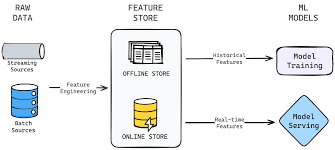
- Key Components and Architecture of a Feature Store.
- Case Study: The challenges faced by a large e-commerce company before adopting a feature store for personalized recommendations.
Module 2: Core Concepts of Feature Engineering for Production
- Review of Feature Engineering Techniques relevant to Feature Stores.
- Handling Categorical, Numerical, and Time-Series Features.
- Feature Transformation and Normalization for ML Models.
- Importance of Reproducible Feature Engineering Pipelines.
- Case Study: How a financial institution optimized fraud detection models by standardizing complex transactional features.
Module 3: Feature Store Architecture: Offline and Online Stores
- Deep Dive into Offline Feature Stores for Batch Processing and Training.
- Understanding Online Feature Stores for Real-time Inference.
- Data Synchronization Strategies between Offline and Online Stores.
- Trade-offs and Design Considerations for each store type.
- Case Study: Designing a dual-store architecture for a ride-sharing app to handle both historical driver data and real-time location updates.
Module 4: Designing the Feature Registry and Metadata Management
- The Role of a Centralized Feature Registry for Discoverability.
- Metadata Management: Feature Definitions, Owners, and Documentation.
- Implementing Search and Discovery Capabilities for Features.
- Schema Evolution and Managing Changes to Feature Definitions.
- Case Study: Building a searchable feature catalog for a large enterprise with thousands of features across different departments.
Module 5: Data Ingestion and Transformation Pipelines
- Building Robust ETL/ELT Pipelines for Feature Store Ingestion.
- Batch Data Ingestion from Data Lakes and Warehouses.
- Streaming Data Ingestion from Kafka, Kinesis, or Event Hubs.
- Data Validation, Cleaning, and Error Handling in Pipelines.
- Case Study: Implementing a streaming pipeline to ingest sensor data for predictive maintenance features.
Module 6: Implementing Feature Serving for Training
- Generating Point-in-Time Correct Training Datasets.
- Offline Feature Retrieval Strategies and Batch Joins.
- Handling Time Travel Queries for Historical Feature Values.
- Integration with ML Training Frameworks (e.g., TensorFlow, PyTorch, Scikit-learn).
- Case Study: Creating accurate training datasets for a customer churn prediction model, considering feature values at the time of churn.
Module 7: Implementing Feature Serving for Inference
- Low-Latency Online Feature Retrieval for Real-time Predictions.
- Caching Strategies for Hot Features in the Online Store.
- API Design for Feature Serving Endpoints.
- Ensuring Consistency between Training and Serving Features.
- Case Study: Optimizing feature retrieval for a real-time recommendation engine to achieve millisecond latency.
Module 8: Open-Source Feature Stores: Deep Dive into Feast
- Introduction to Feast: Architecture, Concepts, and Components.
- Setting up and Configuring a Feast Feature Store.
- Defining Feature Views and Entities in Feast.
- Ingesting Data and Serving Features using Feast SDK.
- Case Study: Migrating an existing feature pipeline to Feast for a content personalization platform.
Module 9: Advanced Feature Store Integrations
- Integrating Feature Stores with MLOps Platforms (e.g., MLflow, Kubeflow).
- Connecting to various Data Sources (e.g., Snowflake, BigQuery, S3, Redis).
- Orchestrating Feature Pipelines with Airflow or Prefect.
- Deployment Strategies for Feature Store Services (e.g., Kubernetes, Docker).
- Case Study: Building an end-to-end MLOps pipeline with a feature store as the central data component.
Module 10: Feature Monitoring and Observability
- Detecting Feature Drift and Data Quality Issues.
- Monitoring Feature Usage, Freshness, and Completeness.
- Alerting and Anomaly Detection for Feature Data.
- Implementing Dashboards and Visualizations for Feature Health.
- Case Study: Setting up real-time monitoring for a credit scoring model's features to detect sudden shifts in customer demographics.
Module 11: Feature Governance, Security, and Access Control
- Implementing Role-Based Access Control (RBAC) for Features.
- Data Masking and Anonymization for Sensitive Features.
- Auditing Feature Access and Usage.
- Compliance with Data Regulations (e.g., GDPR, CCPA).
- Case Study: Ensuring data privacy and regulatory compliance for medical imaging features in a healthcare ML system.
Module 12: Scaling Feature Stores: Distributed Systems & Performance
- Strategies for Scaling Feature Storage and Serving.
- Distributed Computing Frameworks for Feature Computation (e.g., Spark, Dask).
- Optimizing Query Performance and Throughput.
- Handling High-Cardinality and Sparse Features.
- Case Study: Scaling a feature store to handle millions of transactions per second for a global payment processing system.
Module 13: Feature Store in the Cloud: AWS, GCP, Azure Offerings
- Overview of Cloud-Native Feature Store Services (e.g., Amazon SageMaker Feature Store, Google Cloud Vertex AI Feature Store, Azure Machine Learning Feature Store).
- Benefits and Limitations of Managed Cloud Services.
- Integrating on-premise data with cloud feature stores.
- Cost Management and Optimization in Cloud Environments.
- Case Study: Choosing between a self-managed Feast instance and a managed cloud feature store for a growing startup.
Module 14: Advanced Topics and Future Trends in Feature Stores
- Automated Feature Engineering and Feature Discovery.
- Graph-Based Features and Graph Neural Networks (GNNs) with Feature Stores.
- Feature Store Federation and Cross-Organization Feature Sharing.
- Ethical AI and Bias Detection through Feature Analysis.
- Case Study: Exploring the use of graph features for a social network analysis application.
Module 15: Building a Production-Ready Feature Store: Project & Best Practices
- End-to-End Project: Designing, Implementing, and Deploying a Mini Feature Store.
- Best Practices for Feature Store Design and Operation.
- Common Pitfalls and How to Avoid Them.
- Team Collaboration and Workflow Optimization.
- Case Study: A capstone project where participants design and prototype a feature store for a hypothetical business problem.
Training Methodology
This course employs a participatory and hands-on approach to ensure practical learning, including:
- Interactive lectures and presentations.
- Group discussions and brainstorming sessions.
- Hands-on exercises using real-world datasets.
- Role-playing and scenario-based simulations.
- Analysis of case studies to bridge theory and practice.
- Peer-to-peer learning and networking.
- Expert-led Q&A sessions.
- Continuous feedback and personalized guidance.
Register as a group from 3 participants for a Discount
Send us an email: info@datastatresearch.org or call +254724527104
Certification
Upon successful completion of this training, participants will be issued with a globally- recognized certificate.
Tailor-Made Course
We also offer tailor-made courses based on your needs.
Key Notes
a. The participant must be conversant with English.
b. Upon completion of training the participant will be issued with an Authorized Training Certificate
c. Course duration is flexible and the contents can be modified to fit any number of days.
d. The course fee includes facilitation training materials, 2 coffee breaks, buffet lunch and A Certificate upon successful completion of Training.
e. One-year post-training support Consultation and Coaching provided after the course.
f. Payment should be done at least a week before commence of the training, to DATASTAT CONSULTANCY LTD account, as indicated in the invoice so as to enable us prepare better for you.