Ecosystem-Based Adaptation (EbA) Planning Training Course
Ecosystem-Based Adaptation (EbA) Planning Training Course provides an essential framework for integrating natural solutions into climate change adaptation strategies.
Course Overview
Ecosystem-Based Adaptation (EbA) Planning Training Course
Introduction
Ecosystem-Based Adaptation (EbA) Planning Training Course provides an essential framework for integrating natural solutions into climate change adaptation strategies. This course delves into the critical role of biodiversity and ecosystem services in building climate resilience for both human communities and natural systems. By focusing on nature-based solutions, participants will gain the knowledge and practical skills to design and implement sustainable adaptation projects that deliver multiple environmental, social, and economic co-benefits. This training is designed to empower a new generation of professionals to lead the transition towards a more resilient and nature-positive future.
Our program emphasizes a holistic, multi-sectoral approach to adaptation planning. It moves beyond traditional engineering solutions to showcase how the conservation, restoration, and sustainable management of ecosystems can be a cost-effective and powerful tool for reducing climate risks. Participants will learn to conduct vulnerability and climate risk assessments, identify and value EbA measures, and develop robust monitoring and evaluation frameworks. The course content is grounded in real-world case studies and best practices from around the globe, ensuring that the knowledge gained is directly applicable to a variety of contexts, from coastal protection to urban resilience and food security.
Course Duration
10 days
Course Objectives
Upon completion of this course, participants will be able to:
- Define and conceptualize Ecosystem-Based Adaptation (EbA) and its role in climate resilience planning.
- Assess climate vulnerabilities and risks using an ecosystem-based lens.
- Identify and appraise various nature-based solutions for climate change adaptation.
- Develop a comprehensive EbA project design that integrates socio-economic factors and local knowledge.
- Conduct an economic valuation of EbA projects to demonstrate their cost-effectiveness.
- Formulate strategies for mainstreaming EbA into national, sectoral, and local development policies.
- Integrate gender equality, human rights, and indigenous knowledge into EbA initiatives.
- Design a robust monitoring, evaluation, and learning (MEL) framework for adaptive management.
- Explore diverse financing mechanisms and funding opportunities for EbA projects.
- Apply participatory and stakeholder engagement techniques in the EbA planning process.
- Differentiate between EbA and other adaptation strategies and identify potential synergies.
- Communicate the multiple benefits and co-benefits of EbA to different audiences.
- Lead and manage an interdisciplinary team in the planning and implementation of EbA.
Organizational Benefits
- Builds internal capacity and a specialized team capable of designing, implementing, and managing cutting-edge climate adaptation projects.
- Positions the organization as a leader in innovative and sustainable solutions, attracting new funding and partnerships.
- Improves the ability to assess and manage climate-related risks to assets, operations, and communities, enhancing long-term operational resilience.
- Directly contributes to the achievement of multiple SDGs, including Climate Action, Life on Land, and Sustainable Cities and Communities, strengthening corporate social responsibility and reporting.
- Enables the use of cost-effective, long-term solutions that often provide greater returns than traditional hard infrastructure, reducing future capital and maintenance costs.
- Fosters collaboration and builds trust with communities, governments, and other stakeholders through participatory and inclusive project planning.
Target Audience
- Government Officials and Policy Makers.
- Project Managers and Technical Experts from NGOs, civil society organizations, and international development agencies.
- Urban Planners and Infrastructure Developers.
- Environmental Consultants and Researchers.
- Natural Resource Managers and Conservation Practitioners.
- Academics and University Students in fields such as environmental science, geography, and sustainable development.
- Private Sector professionals in sectors vulnerable to climate change, such as agriculture, tourism, and real estate.
- Community Leaders and advocates working on the frontlines of climate impacts.
Course Modules
Module 1: Foundations of Climate Change and Ecosystems
- Introduction to climate change impacts and the concept of vulnerability and exposure.
- Understanding ecosystem services and their role in human well-being.
- Defining Ecosystem-Based Adaptation (EbA) and its core principles.
- The connection between biodiversity loss and climate vulnerability.
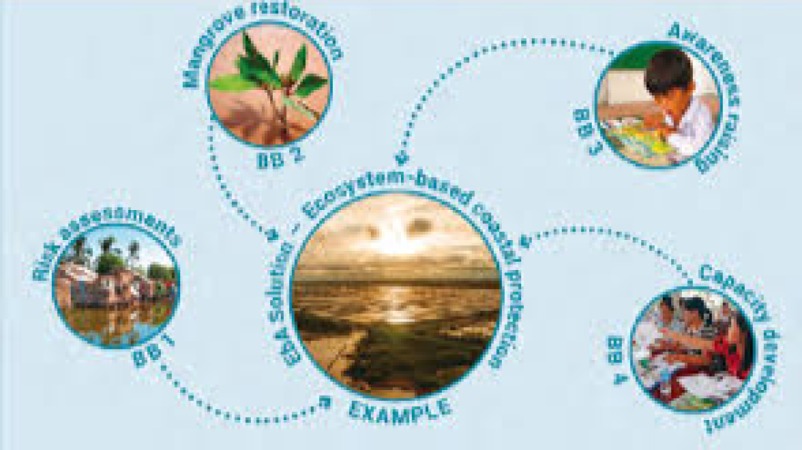
- Case Study: The role of mangrove ecosystems in protecting coastal communities from storm surges and sea-level rise in Southeast Asia.
Module 2: The EbA Planning Cycle
- An overview of the iterative EbA planning cycle.
- Initiating an EbA project: from problem identification to goal setting.
- Stakeholder mapping and engagement for inclusive planning.
- Developing a Theory of Change for an EbA project.
- Case Study: The planning process for a community-led watershed restoration project to improve water security in a drought-prone region of Africa.
Module 3: Vulnerability and Climate Risk Assessment
- Conducting a climate risk assessment at different scales (local, national).
- Analyzing social, ecological, and economic vulnerabilities.
- Using data and tools for vulnerability mapping.
- Identifying key climate hazards and their potential impacts.
- Case Study: A climate risk assessment for an agricultural community facing changing rainfall patterns in the Sahel region, identifying vulnerabilities related to food security and livelihoods.
Module 4: Designing and Appraising EbA Measures
- Identifying and shortlisting potential nature-based solutions.
- Applying the EbA Mainstreaming Framework.
- Screening criteria for selecting the most appropriate measures.
- Evaluating the technical feasibility and long-term sustainability of EbA interventions.
- Case Study: The design and appraisal of agroforestry systems and soil conservation techniques to build resilience in a mountain community in Nepal.
Module 5: Economic Valuation and Cost-Benefit Analysis
- Introduction to the economic valuation of ecosystems.
- Conducting a cost-benefit analysis (CBA) for EbA projects.
- Monetizing the co-benefits of EbA, such as improved public health, biodiversity, and carbon sequestration.
- Understanding the financial viability of EbA projects.
- Case Study: A cost-benefit analysis of a green infrastructure project in a city, demonstrating how urban green spaces reduce flood damage and improve air quality, resulting in significant savings.
Module 6: Mainstreaming and Policy Integration
- Understanding the institutional and policy context for EbA.
- Strategies for mainstreaming EbA into national adaptation plans and development strategies.
- Developing compelling proposals for policymakers and donors.
- Navigating inter-sectoral coordination and governance challenges.
- Case Study: The successful integration of EbA into a national water resource management policy in a country in Latin America.
Module 7: Implementation and Adaptive Management
- Developing a detailed project implementation plan.
- Setting up effective project governance and management structures.
- Understanding the principles of adaptive management in a climate context.
- Dealing with unforeseen challenges and adapting project interventions.
- Case Study: A post-implementation review of a coral reef restoration project in the Caribbean, highlighting lessons learned and adaptive strategies to improve project outcomes.
Module 8: Monitoring, Evaluation, and Learning (MEL)
- Designing an EbA-specific MEL framework.
- Selecting appropriate process-based and results-based indicators.
- Developing a system for data collection and analysis.
- Using MEL to inform decision-making and project reporting.
- Case Study: The use of remote sensing and community-based monitoring to track the progress and impacts of a large-scale land restoration project in a dryland region.
Module 9: Funding and Financing EbA
- Identifying and accessing different sources of climate finance.
- Exploring opportunities from the Green Climate Fund and other multilateral funds.
- Developing a compelling financing proposal.
- Understanding public-private partnerships and innovative financing mechanisms.
- Case Study: A successful proposal for funding a coastal defense project that combined public funds with private sector investment in ecotourism.
Module 10: Gender, Equity, and Social Inclusion
- Understanding how climate impacts and adaptation strategies affect different social groups.
- Integrating gender analysis and human rights into EbA projects.
- Harnessing the power of traditional and indigenous knowledge.
- Ensuring inclusive decision-making and benefit-sharing.
- Case Study: An EbA project in a rural community where the inclusion of women in planning led to the successful implementation of new, resilient farming practices.
Module 11: Cross-Sectoral Applications of EbA
- EbA in urban environments: green infrastructure for heat island mitigation and flood control.
- EbA for food security and agriculture: climate-smart agriculture and agroforestry.
- EbA in disaster risk reduction (DRR).
- EbA for water security.
- Case Study: The use of urban green spaces and permeable pavements to manage storm runoff and reduce the risk of flash flooding in a major city.
Module 12: Communication and Knowledge Sharing
- Developing an effective communication strategy for EbA.
- Communicating the multiple benefits of nature-based solutions to different audiences.
- Using storytelling and visual media to share project successes.
- Facilitating knowledge exchange and South-South cooperation.
- Case Study: A multi-media campaign that successfully raised public awareness about the benefits of wetland restoration for local livelihoods and flood protection.
Module 13: Capstone Project: EbA Project Design
- Working in small groups to develop a complete EbA project proposal.
- Presenting the project concept, including vulnerability assessment, proposed measures, and MEL plan.
- Receiving feedback from instructors and peers.
- Finalizing the project proposal for a real-world or simulated context.
Module 14: Final Exam and Certification
Module 15: Post-Training Mentorship and Community of Practice
Training Methodology
This course uses a blended, adult learning methodology that combines theoretical knowledge with practical application. The approach is highly interactive and participatory, including:
- Instructor-led presentations and expert lectures.
- Interactive group discussions and problem-solving exercises.
- Real-world case studies analysis and debriefing.
- Practical workshops and hands-on activities.
- Role-playing scenarios to simulate project planning and stakeholder engagement.
- Mentored project work where participants develop a preliminary EbA plan for a real or hypothetical site.
- Peer-to-peer learning and feedback sessions.
- Access to a curated library of resources, tools, and best practices.
Register as a group from 3 participants for a Discount
Send us an email: info@datastatresearch.org or call +254724527104
Certification
Upon successful completion of this training, participants will be issued with a globally- recognized certificate.
Tailor-Made Course
We also offer tailor-made courses based on your needs.
Key Notes
a. The participant must be conversant with English.
b. Upon completion of training the participant will be issued with an Authorized Training Certificate
c. Course duration is flexible and the contents can be modified to fit any number of days.
d. The course fee includes facilitation training materials, 2 coffee breaks, buffet lunch and A Certificate upon successful completion of Training.
e. One-year post-training support Consultation and Coaching provided after the course.
f. Payment should be done at least a week before commence of the training, to DATASTAT CONSULTANCY LTD account, as indicated in the invoice so as to enable us prepare better for you.